 English
 简体中文
简体中文  Español
  Português
  русский
  Français
  日本語
日本語  Deutsch
  tiếng Việt
  Italiano
  Nederlands
  ภาษาไทย
  Polski
  한국어
한국어  Svenska
  magyar
  Malay
Malay  বাংলা ভাষার
  Dansk
Dansk  Suomi
Suomi  हिन्दी
  Pilipino
  Türkçe
  Gaeilge
  العربية
  Indonesia
  Norsk
Norsk  تمل
تمل  český
český  ελληνικά
  український
  Javanese
  فارسی
فارسی  தமிழ்
தமிழ்  తెలుగు
  नेपाली
  Burmese
  български
  ລາວ
ລາວ  Latine
  Қазақша
  Euskal
  Azərbaycan
  Slovenský jazyk
  Македонски
  Lietuvos
  Eesti Keel
  Română
  Slovenski
  मराठी
मराठी


Why Is the Solid Wall Pipe Extrusion Line Becoming the Preferred Solution for High-Strength Piping Production?
The Solid Wall Pipe Extrusion Line has become a central manufacturing technology for producing high-strength, durable, and high-precision pipelines used in water supply, drainage, industrial systems, and urban infrastructure.
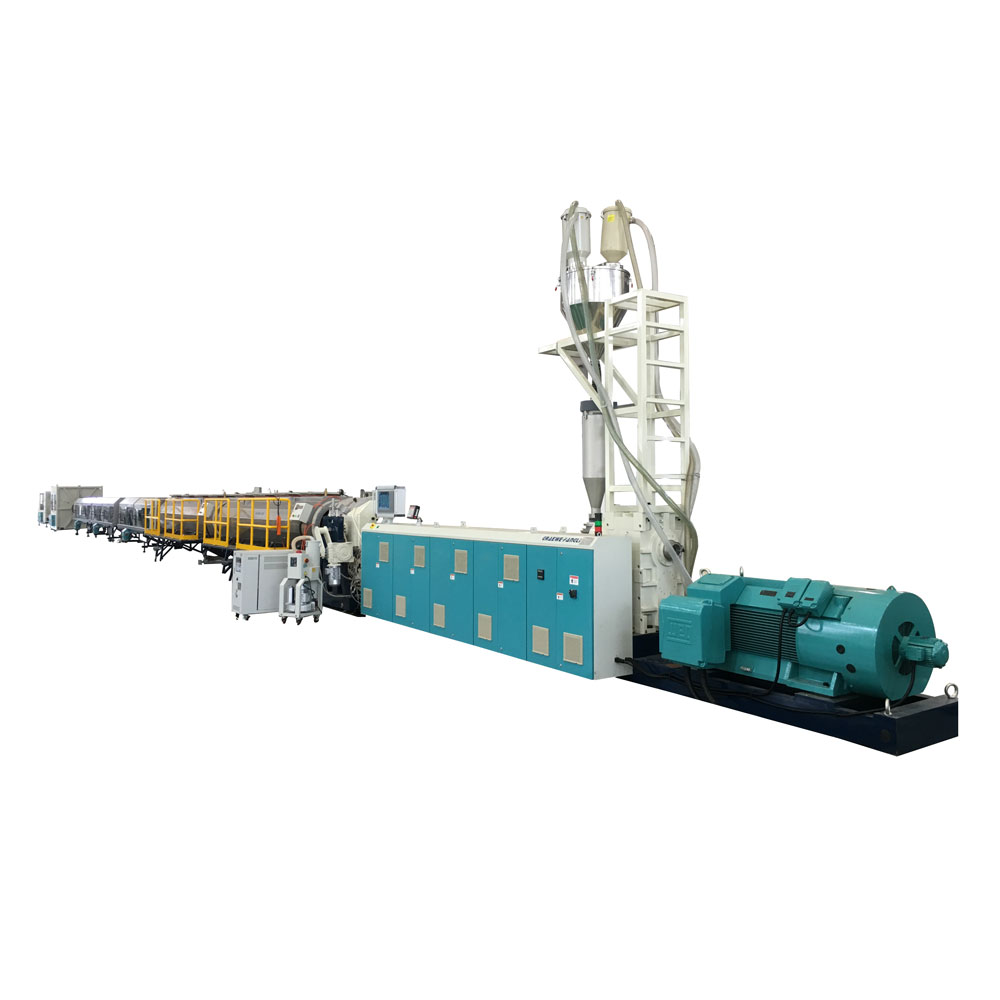
How Does a Solid Wall Pipe Extrusion Line Work to Ensure High-Quality Pipe Production?
A Solid Wall Pipe Extrusion Line operates through a controlled and continuous process that melts, shapes, cools, and forms thermoplastic materials—primarily HDPE, PP, or PVC—into high-strength pipes. Its design emphasizes consistency, high-speed output, and dimensional accuracy. Understanding how each component functions helps manufacturers choose the right equipment for scaling production while maintaining strict quality standards.
Core Components and Functional Flow
-
Extruder
-
Melts raw materials using a high-efficiency screw mechanism
-
Ensures stable temperature control
-
Provides uniform plasticization to avoid pipe defects
-
-
Extrusion Die Head
-
Shapes molten material into solid wall pipes
-
Maintains thickness uniformity and structural strength
-
-
Vacuum Calibration Tank
-
Stabilizes the pipe dimension through vacuum cooling
-
Enhances roundness and ensures exact calibration
-
-
Cooling Tanks
-
Multiple stages of water cooling improve crystallization
-
Protects mechanical properties of pipes
-
-
Haul-Off Unit
-
Controls pipe pulling speed
-
Ensures smooth surface finish and consistent wall thickness
-
-
Cutting Machine
-
High-precision cutters ensure clean and accurate pipe lengths
-
-
Stacker or Winder
-
Collects finished pipes efficiently
-
Reduces manual handling
-
What Key Specifications Define the Performance of a Solid Wall Pipe Extrusion Line?
To evaluate the capability of a Solid Wall Pipe Extrusion Line, manufacturers rely on several technical indicators including output capacity, extrusion stability, compatibility with materials, and automation level. Below is a professional specification reference table:
Technical Parameters Overview
| Parameter Category | Specification Range | Manufacturing Impact |
|---|---|---|
| Pipe Diameter Range | 16–1600 mm | Suitable for small household pipes to large municipal pipelines |
| Extruder Model | Single/Double Screw | Determines melting uniformity and output strength |
| Output Capacity | 150–1200 kg/h | Higher output supports large-scale industrial projects |
| Raw Materials | HDPE, PP, PVC | Flexible production of multiple pipe types |
| Line Speed | 0.2–12 m/min | Faster speed increases productivity |
| Cooling System | Multi-stage water cooling | Ensures shape stability and mechanical strength |
| Control System | PLC + Touch Screen | Automates process management for accuracy |
| Energy Efficiency | High-efficiency motors & heaters | Reduces operating cost and improves sustainability |
These parameters help determine how the extrusion line performs under heavy-duty use, how it maintains structural integrity, and how it accommodates diverse pipe specifications in construction, agriculture, sanitation, and industrial applications.
Why Is the Solid Wall Pipe Extrusion Line Considered a Future-Ready Manufacturing System?
The rising global demand for high-strength, corrosion-resistant, and long-lifespan pipelines is pushing manufacturers toward more advanced extrusion systems. The Solid Wall Pipe Extrusion Line aligns with multiple future trends:
a. Demand for Sustainable Infrastructure
HDPE and PP pipes are recyclable, lightweight, and long-lasting. As governments shift toward sustainable urban solutions, demand for large-diameter HDPE sewer pipes and pressure pipes continues to grow.
b. Automation and Precision Technology
Automated PLC systems improve production efficiency, reduce human error, and maintain consistent pipe quality—core expectations for modern manufacturing.
c. Material Innovation
Future extrusion lines increasingly support:
-
modified polyolefins
-
antimicrobial PVC
-
high-temperature-resistant PP
These advanced materials expand application fields such as chemical plants, gas systems, and high-pressure fluid transport.
d. Digital Production Monitoring
Real-time data monitoring helps manufacturers evaluate:
-
temperature stability
-
extrusion pressure
-
pipe ovality
-
thickness uniformity
Predictive maintenance and digital tracking are becoming standard requirements.
e. Increased Market Demand for Large-Diameter Pipes
Municipal water and underground infrastructure projects require robust pipes up to 1600 mm. Modern extrusion lines provide the mechanical consistency needed for these demanding applications.
The Solid Wall Pipe Extrusion Line not only meets current production needs but also adapts to evolving industry expectations, making it a long-term investment for manufacturers.
How Does the Solid Wall Pipe Extrusion Line Deliver Production Advantages in Real Manufacturing Environments?
The advantages are not limited to speed and output capacity. They also reflect how the technology improves product lifecycle value, reduces production cost, and enhances project application reliability.
Major Performance Advantages
1. High Strength and Excellent Pressure Resistance
The consistent melting and shaping process ensures pipes remain structurally sound during installation and long-term use.
2. Stable Production Output
High-torque extruders provide stable melt flow, allowing long continuous runs without interruption.
3. Superior Dimensional Accuracy
Vacuum calibration and advanced die designs ensure uniform wall thickness and reduce deviations.
4. Energy-Efficient Operation
Energy-saving heaters and motors reduce electricity consumption, lowering operating costs in large-scale production facilities.
5. Wide Processing Compatibility
One extrusion line can produce:
-
potable water pipes
-
drainage pipes
-
industrial fluid pipes
-
agricultural irrigation pipes
6. Low Maintenance Demand
Simplified mechanical structure ensures lower maintenance frequency and easier component replacement.
7. Enhanced Pipe Performance
Pipes produced by this line typically exhibit:
-
excellent chemical resistance
-
corrosion resistance
-
smooth surface finish
-
long service life
These characteristics make solid wall pipes ideal for demanding industrial and municipal applications.
Frequently Asked Questions
Q1: How long is the typical service life of solid wall pipes produced by this system?
A: Solid wall pipes such as HDPE and PVC can reach a service life exceeding 50 years. The extrusion line’s stable processing technology ensures uniform molecular structure, which significantly improves resistance to pressure, corrosion, and environmental stress cracking. The reliable manufacturing process directly contributes to the pipe's long-term durability.
Q2: How can manufacturers ensure the extrusion line maintains consistent quality during high-speed production?
A: Quality consistency depends on proper calibration, stable screw temperature zones, precise haul-off speed control, and regular maintenance of the die head. PLC control systems monitor real-time data such as melt pressure, temperature fluctuation, and haul-off tension to ensure each section of pipe meets dimensional and mechanical specifications.
How Can a Reliable Partner Help Manufacturers Upgrade Their Pipe Production Capability?
In a market driven by quality, performance, and long-term reliability, the Solid Wall Pipe Extrusion Line stands out as a high-value manufacturing solution suitable for infrastructure, industrial piping, and municipal engineering. Its advanced design ensures uniform melting, accurate sizing, high-speed output, and long-lasting stability, supporting manufacturers seeking to expand production capacity and adapt to global construction growth.
A strong equipment supplier plays a crucial role in guaranteeing stable operations, timely technical support, and long-term customer success. Fangli, as an industry-recognized extrusion equipment manufacturer, offers high-precision Solid Wall Pipe Extrusion Lines engineered for durability, efficiency, and scalable production needs. Its solutions integrate modern process control, energy-saving systems, and operator-friendly configurations that help global users achieve consistent and reliable pipe manufacturing performance.
For consultation, equipment selection assistance, or customized production solutions, contact us to explore how advanced extrusion technology can enhance your manufacturing capabilities.
Send Inquiry


X
We use cookies to offer you a better browsing experience, analyze site traffic and personalize content. By using this site, you agree to our use of cookies.
Privacy Policy