 English
 简体中文
简体中文  Español
  Português
  русский
  Français
  日本語
日本語  Deutsch
  tiếng Việt
  Italiano
  Nederlands
  ภาษาไทย
  Polski
  한국어
한국어  Svenska
  magyar
  Malay
Malay  বাংলা ভাষার
  Dansk
Dansk  Suomi
Suomi  हिन्दी
  Pilipino
  Türkçe
  Gaeilge
  العربية
  Indonesia
  Norsk
Norsk  تمل
تمل  český
český  ελληνικά
  український
  Javanese
  فارسی
فارسی  தமிழ்
தமிழ்  తెలుగు
  नेपाली
  Burmese
  български
  ລາວ
ລາວ  Latine
  Қазақша
  Euskal
  Azərbaycan
  Slovenský jazyk
  Македонски
  Lietuvos
  Eesti Keel
  Română
  Slovenski
  मराठी
मराठी


Analysis of Plasticization Mechanism in Various Zones of Twin-Screw Extruder for PVC Products
Ningbo Fangli Technology Co., Ltd. is a mechanical equipment manufacturer with more than 30 years’ experiences of plastic pipe extrusion equipment, new environmental protection and new materials equipment. Since its establishment Fangli has been developed based on user’s demands. Through continuous improvement, independent R&D on the core technology and digestion & absorption of advanced technology and other means, we have developed PVC pipe extrusion line, PP-R pipe extrusion line, PE water supply / gas pipe extrusion line, which was recommended by the Chinese Ministry of Construction to replace imported products. We have gained the title of “First-class Brand in Zhejiang Province”.
Based on the plasticization process of PVC material in a twin-screw extruder, the screw is divided into three zones: the solid conveying zone, the melting zone, and the melt conveying (extrusion) zone.
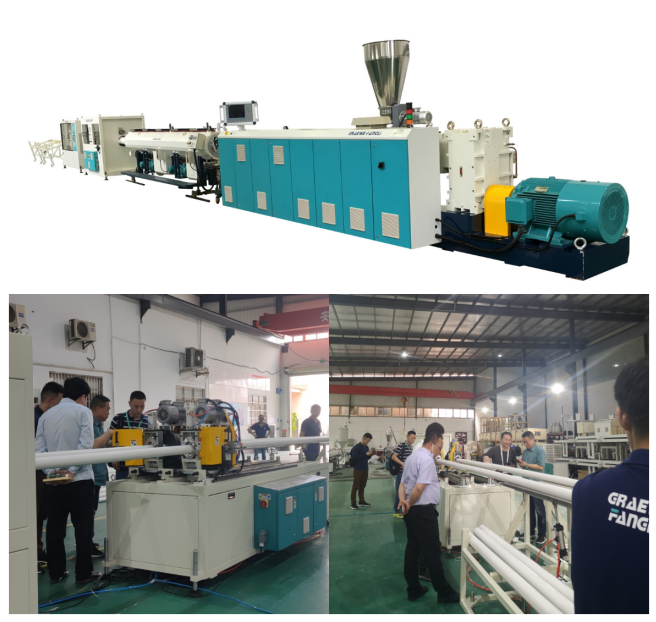
I. Plasticization Mechanism in the Solid Conveying Zone
In the barrel, the area where solid polymer (PVC) and its additives flow, are preheated, and compacted is defined as the solid conveying zone. Firstly, the flow of solid polymer particles from the hopper into the barrel is achieved by gravity. As the screw rotates, the particles are conveyed towards the die head while particles in the hopper continuously flow. In the solid conveying zone (Barrel C1 zone), the macromolecules, small molecules, and other particles within the PVC material are gradually heated. Simultaneously, shear from the screw and friction between particles also increase the particles' heat, allowing them to fully contact, diffuse, and penetrate in a compacted state.
In this zone, due to changes in the screw pitch, flight width, etc., the PVC material particles are densely compacted, forming a solid bed or solid plug that slides along the screw channel. The movement of the solid plug relies on the friction between the barrel surface and the solid plug, while the friction between the screw and the solid plug hinders its movement. Therefore, inside the barrel, PVC material particles do not advance uniformly in the same direction but instead tumble, slip, rotate with the screw, and "bridge" periodically. They pile up behind the "bridge," which then breaks, and the process repeats continuously with the extrusion of PVC material and the flow of material within the hopper.
In this zone, good quality of PVC extrusion and plasticization is indicated by the transition of PVC from a glassy state to a high-elastic state. From the perspective of aggregated state structure, it involves 50% to 60% of PVC resin particles breaking down into primary particles, with the surfaces of various additive particles fully contacting and diffusing with these primary particles.
It is worth noting that for stable operation, the height of the solid material in the hopper must always be above a certain critical value. Above this critical value, changes in the material height will not affect the extruder's performance. However, if the material height falls below the critical value, it becomes a significant factor of instability. Changes in the solid material height cause variations in pressure at the bottom, which can alter the extruder's operating conditions and lead to deterioration in the quality of PVC extrusion and plasticization.
II. Plasticization Mechanism in the Melting Zone
In the barrel, the area where solid polymer and melt coexist is defined as the melting zone or phase transition zone. This zone corresponds to the C2 and C3 heating zones. The melting zone is a crucial part of the extruder. Parameters such as temperature settings (Barrel C2 zone, C3 zone, screw core), screw speed, the gap between screws, and the gap between the screw and barrel significantly impact the quality of PVC extrusion. When PVC material reaches the melting zone, due to changes in screw pitch, flight width, etc., the PVC particles are compacted densely and have already generated considerable pressure. This pressure, combined with the softening effect of the surrounding heat medium, transforms the compacted particles into a dense "solid bed." This solid bed is a mixed state consisting partly of PVC in a high-elastic state, partly in a glassy state, and a small amount in a viscous-flow state. The solid bed takes the shape of the helical screw channel and slides within it. Due to this relative motion, a velocity distribution is generated within the melt film between the solid bed and the barrel surface. Consequently, melt in the film begins to flow towards the pushing flight. When it encounters the flight, the flight "scrapes" the melt off the barrel, collecting it in the melt pool at the rear of the channel ahead of the pushing flight. As the solid bed moves along the channel, more and more melt is carried into the melt pool. Thus, the size of the melt pool increases while the size of the solid bed decreases. The solid bed is gradually destroyed and conveyed forward in a viscous-flow state.
In this zone, good quality of PVC extrusion and plasticization is indicated by the transition of PVC from a high-elastic state to a viscous-flow state. From the perspective of aggregated state structure, 60-70% of PVC primary particles break down into first-order particles, and various additive molecules contact the PVC first-order particles, forming physical and chemical bonds.
Factors that improve the quality of PVC extrusion and plasticization in the melting zone include:
(1) Increasing screw speed;
(2) Raising the set temperature of the barrel in the melting zone;
(3) Appropriate gap between the screw and barrel.
For a specific PVC profile production formulation, there should be an optimal set of barrel temperatures for the melting zone.
III. Plasticization Mechanism in the Melt Conveying Zone
In the barrel, the area where the solid polymer is completely converted into melt, and the melt is forcibly conveyed to the die head, is defined as the melt conveying zone (Barrel C4 heating zone). In this zone, the molten macromolecules further react and homogenize with various additives under shear action. As the PVC viscous fluid is continuously and quantitatively extruded, melt pressure is formed, ensuring the compactness of the final formed PVC product. In this zone, good quality of PVC extrusion and plasticization is indicated by the PVC macromolecules maintaining their viscous-flow state. From the perspective of aggregated state structure, it is a crystalline structure composed of PVC first-order particles along with a small number of primary particles. These remaining primary particles can enhance the strength and toughness of the final material. When material containing such crystals is extruded and cooled, the primary particles can hinder the movement of the first-order particles under external force, leading to increased strength. Furthermore, due to their large surface area, the primary particles can absorb part of the impact energy when subjected to shock, improving toughness.
If you need more information, Ningbo Fangli Technology Co., Ltd. welcomes you to contact for a detailed inquiry, we will provide you with professional technical guidance or equipment procurement suggestions.
Send Inquiry


X
We use cookies to offer you a better browsing experience, analyze site traffic and personalize content. By using this site, you agree to our use of cookies.
Privacy Policy