 English
 简体中文
简体中文  Español
  Português
  русский
  Français
  日本語
日本語  Deutsch
  tiếng Việt
  Italiano
  Nederlands
  ภาษาไทย
  Polski
  한국어
한국어  Svenska
  magyar
  Malay
Malay  বাংলা ভাষার
  Dansk
Dansk  Suomi
Suomi  हिन्दी
  Pilipino
  Türkçe
  Gaeilge
  العربية
  Indonesia
  Norsk
Norsk  تمل
تمل  český
český  ελληνικά
  український
  Javanese
  فارسی
فارسی  தமிழ்
தமிழ்  తెలుగు
  नेपाली
  Burmese
  български
  ລາວ
ລາວ  Latine
  Қазақша
  Euskal
  Azərbaycan
  Slovenský jazyk
  Македонски
  Lietuvos
  Eesti Keel
  Română
  Slovenski
  मराठी
मराठी


Key Focus Areas for Production Quality Commissioning of PE Steel Wire Mesh Skeleton Pipes
Ningbo Fangli Technology Co., Ltd. is a mechanical equipment manufacturer with over 30 years’ experiences of plastic pipe extrusion equipment, new environmental protection and new materials equipment. Since its establishment Fangli has been developed based on user’s demands. Through continuous improvement, independent R&D on the core technology and digestion & absorption of advanced technology and other means, we have developed PVC pipe extrusion line, PP-R pipe extrusion line, PE water supply / gas pipe extrusion line, which was recommended by the Chinese Ministry of Construction to replace imported products. We have gained the title of “First-class Brand in Zhejiang Province”.
During the production quality commissioning of PE steel wire mesh skeleton pipes, core indicators such as the bonding strength between the steel wire and the PE layer, structural uniformity, and pressure resistance must be prioritized. The following discussion covers common quality issues, cause analysis, commissioning solutions, and systematic optimization recommendations, along with specific operational guidelines:
I.Common Quality Issues and Cause Analysis
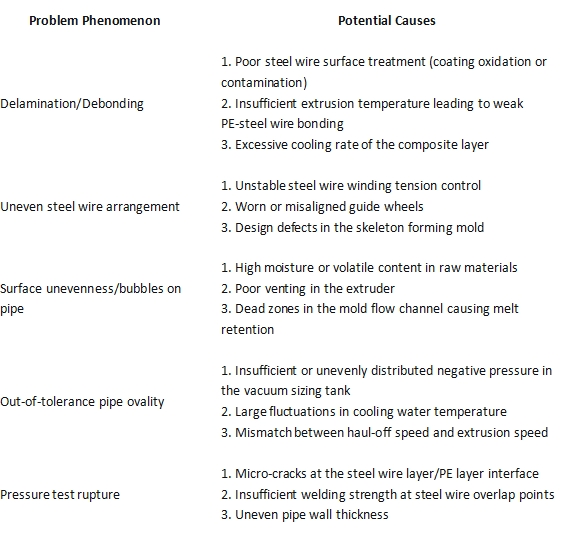
II. Targeted Commissioning Solutions
1. Delamination/Debonding
Solutions:
- Steel wire pretreatment: Inspect the integrity of the galvanized layer (zinc coating ≥60 g/m²); if necessary, add plasma cleaning or chemical activation treatment.
- Temperature optimization: Increase the extruder compounding section temperature (outer PE 220–230°C, inner PE 210–220°C) and extend the contact time between the melt and steel wire.
- Cooling control: Reduce the initial cooling rate of the sizing tank and adopt gradient cooling (e.g., first stage water temperature 40°C, then gradually decrease to 25°C in subsequent stages).
2. Uneven Steel Wire Arrangement
Solutions:
- Tension control: Install dynamic tension sensors to ensure tension error <5% for each steel wire (recommended tension range: 50–80 N).
- Equipment calibration: Replace worn guide wheels and use a laser positioning instrument to adjust guide hole concentricity (deviation ≤0.1 mm).
- Mold improvement: Use spiral winding molds instead of planar winding to enhance the three-dimensional uniformity of the steel wire layer.
3. Surface Defects (Bubbles/Unevenness)
Solutions:
- Raw material treatment: Pre-dry raw materials to a moisture content <0.02% (dry at 80°C for more than 4 hours) and add a defoaming agent (e.g., 0.1%–0.3% silicone masterbatch).
- Venting optimization: Add a vacuum vent port in the compression section of the extruder (vacuum degree -0.08 MPa) to discharge volatile gases.
- Flow channel cleaning: Periodically disassemble the mold and polish the inner wall of the flow channel (Ra ≤0.8 μm) to eliminate melt retention dead zones.
4. Dimensional Stability Issues
Solutions:
- Sizing tank adjustment: Control vacuum degree by zone (inlet zone -0.06 MPa, outlet zone -0.04 MPa) to avoid uneven pipe shrinkage.
- Constant cooling water temperature: Install a cooling water circulation temperature control system (fluctuation within ±1°C).
- Haul-off synchronization: Use a servo motor-driven haul-off machine linked with the extruder screw speed (speed error <0.5%).
5. Insufficient Pressure Resistance
Solutions:
- Interface reinforcement: Coat the steel wire surface with maleic anhydride grafted PE (MAH-g-PE) as an adhesion promoter.
- Welding process: Use high-frequency induction welding instead of traditional resistance welding to ensure steel wire overlap strength ≥90% of the base material.
- Wall thickness monitoring: Install an online X-ray thickness gauge to adjust mold clearance in real time (fluctuation within ±0.1 mm).
III. Systematic Commissioning Process
1. Raw Material and Equipment Pre-inspection
- Inspect steel wire coating thickness (metallographic microscope) and PE raw material melt index (190°C/5 kg).
- Calibrate the extruder temperature control system (verify actual temperature vs. displayed value deviation ≤±3°C with an infrared thermometer).
2. Phased Trial Production
- Phase 1: Low-speed operation (screw speed 15 rpm, haul-off speed 1 m/min) to observe the bonding between the steel wire layer and PE.
- Phase 2: Gradually increase to 80% of the design speed and inspect pipe ovality and surface quality.
- Phase 3: Full-load operation for 8 hours, then sample and conduct a hydrostatic test (1.5 times working pressure held for 1 hour).
3. Key Parameter Recording and Optimization
- Establish a parameter matrix table to record finished product performance under different combinations (e.g., the effect of temperature-tension-vacuum combinations on the debonding rate).
IV. Preventive Measures and Long-term Optimization
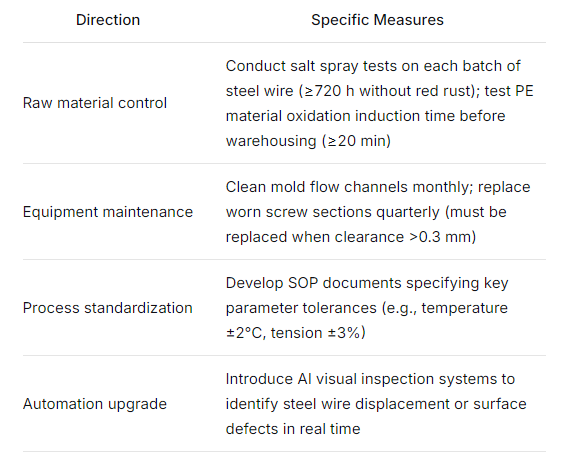
V. Typical Case References
Case 1: A factory experienced frequent pressure test failures in PE steel wire mesh skeleton pipe production. Inspection revealed insufficient steel wire welding point strength. By switching to high-frequency welding and increasing the overlap length from 15 mm to 25 mm, the pass rate increased from 75% to 98%.
Case 2: Periodic surface unevenness on pipes was traced to a blocked extruder vent. After cleaning and increasing vent vacuum to -0.09 MPa, the defect rate dropped by 90%.
VI. Summary
The core of commissioning PE steel wire mesh skeleton pipes lies in "interfacial bonding strength" and "structural uniformity control," requiring coordinated optimization of materials, equipment, and processes. It is recommended to establish a full-process quality traceability system and verify long-term stability through regular third-party testing (e.g., burst pressure tests, peel strength tests). For high-frequency issues, customized solutions can be developed jointly with equipment suppliers (e.g., high-precision tension control systems).
If you need more information, Ningbo Fangli Technology Co., Ltd. welcomes you to contact for a detailed inquiry, we will provide you with professional technical guidance or equipment procurement suggestions.
Send Inquiry


X
We use cookies to offer you a better browsing experience, analyze site traffic and personalize content. By using this site, you agree to our use of cookies.
Privacy Policy