 English
 简体中文
简体中文  Español
  Português
  русский
  Français
  日本語
日本語  Deutsch
  tiếng Việt
  Italiano
  Nederlands
  ภาษาไทย
  Polski
  한국어
한국어  Svenska
  magyar
  Malay
Malay  বাংলা ভাষার
  Dansk
Dansk  Suomi
Suomi  हिन्दी
  Pilipino
  Türkçe
  Gaeilge
  العربية
  Indonesia
  Norsk
Norsk  تمل
تمل  český
český  ελληνικά
  український
  Javanese
  فارسی
فارسی  தமிழ்
தமிழ்  తెలుగు
  नेपाली
  Burmese
  български
  ລາວ
ລາວ  Latine
  Қазақша
  Euskal
  Azərbaycan
  Slovenský jazyk
  Македонски
  Lietuvos
  Eesti Keel
  Română
  Slovenski
  मराठी
मराठी


Illustrated Screw Extruder
Ningbo Fangli Technology Co., Ltd. is a mechanical equipment manufacturer with over 30 years’ experiences of plastic pipe extrusion equipment, new environmental protection and new materials equipment. Since its establishment Fangli has been developed based on user’s demands. Through continuous improvement, independent R&D on the core technology and digestion & absorption of advanced technology and other means, we have developed PVC pipe extrusion line, PP-R pipe extrusion line, PE water supply / gas pipe extrusion line, which was recommended by the Chinese Ministry of Construction to replace imported products. We have gained the title of “First-class Brand in Zhejiang Province”.
We have already witnessed the brute force of fluid conveyance and the precision of gas separation. Now, let’s step into the downstream of the petrochemical industry chain to see how solid high‑polymer materials discharged from reactors are re‑melted, mixed, and extruded into shape.
In this field, the absolute heavy-duty armored vehicle is the Screw Extruder.
If a centrifugal pump is designed for water and low-viscosity liquids, then an extruder is the ultimate weapon for taming ultra-high-viscosity non-Newtonian fluids (polymer melts). Essentially, it is a giant "Archimedes’ screw" housed inside a heated steel barrel.
I. The Three “Purgatorial” Zones of an Extruder
The most fascinating aspect of an extruder is that, simply by varying the geometry of a single screw, it can simultaneously accomplish five tasks inside one piece of equipment: solid conveying, melting, venting, mixing, and pumping.
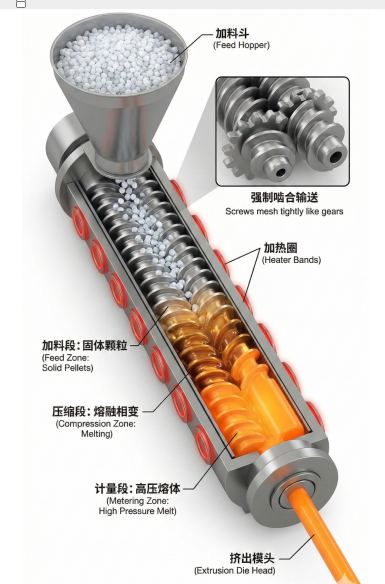
If we cut the barrel open and follow the direction of material travel, the screw is typically divided into three strictly defined functional zones:
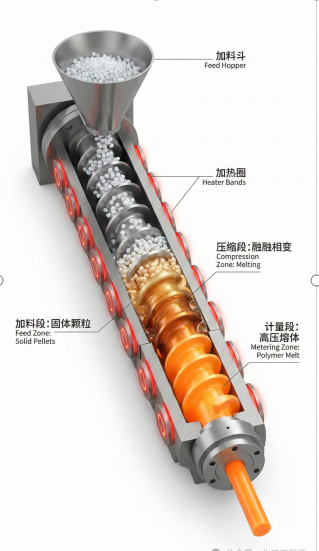
First Zone: Feed Zone --Solid Handler
- Geometry: The deepest screw channel, with the largest volume.
- What happens: Plastic pellets drop in from the hopper on top. The screw rotates, pushing the room‑temperature solid pellets forward continuously, much like a meat grinder. At this stage, the material remains solid.
Second Zone: Compression / Melting Zone – Friction‑Heated Furnace
- Geometry: The root diameter of the screw increases, causing the channel depth to decrease sharply. The space is drastically compressed.
- What happens: This is the toughest part of the entire machine. As the space shrinks, the solid pellets are crushed tightly between the screw and the barrel wall. Intense mechanical shearing and friction generate a huge amount of heat (shear heat). Assisted by the heater bands outside the barrel, the plastic pellets are “forced to fuse” here, transforming from a solid into a viscous molten fluid. Meanwhile, the air trapped between the pellets is forced back out.
Third Zone: Metering Zone – Pressure‑Stabilized Pumping
- Geometry: Extremely shallow and constant channel depth.
- What happens: By this point, all plastic must be 100% homogeneous melt. The very shallow channel generates high pressure, pushing the high‑viscosity melt toward the die orifice with absolutely stable flow rate and pressure – like squeezing toothpaste – to be finally formed into strands, blown into films, or cut into new pellets.
II. Single Screw vs. Twin-Screw
Simple structure, cheap, and durable. It relies mainly on the “friction” between the material and the barrel wall to move the material forward. Mainly used for conventional profiles such as pipes and sheets.
The barrel contains two intermeshing screws (usually co-rotating and parallel). They mesh with each other like gears, providing positive conveying and extremely strong self-wiping action. If you need to incorporate a large amount of color masterbatch, glass fiber, or carry out complex chemical reactions in plastic, the twin-screw extruder is the only choice. Its mixing and shearing capability is tremendously powerful.
If you need more information, Ningbo Fangli Technology Co., Ltd. welcomes you to contact for a detailed inquiry, we will provide you with professional technical guidance or equipment procurement suggestions.
Send Inquiry


X
We use cookies to offer you a better browsing experience, analyze site traffic and personalize content. By using this site, you agree to our use of cookies.
Privacy Policy